7.2.2 Deduce the extent of a reaction from the magnitude of the equilibrium constant
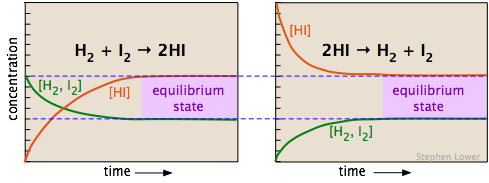
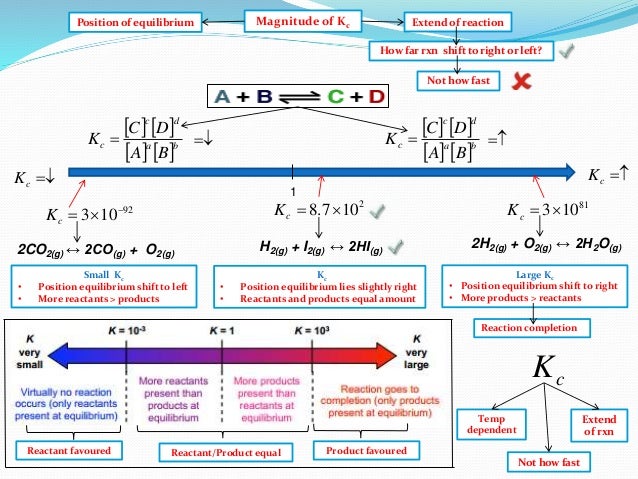
Different reactions have different values of Kc.
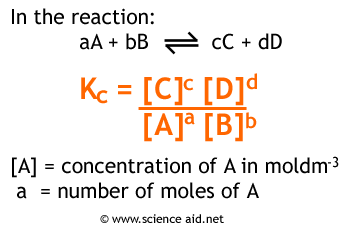
As the equilibrium constant expression puts products on the numerator and reactants on the denominator, a high value of Kc will mean that at equilibrium there are proportionately more products than reactants. In other words, such an equilibrium mixture lies to the right and the reaction goes almost to completion. By contrast a low value of Kc must mean that there are proportionately less products with respect to reactants, so the equilibrium mixture lies to the left and the reaction has barely taken place.
7.2.3 Apply Le Chatelier's principle to predict the qualitative effects of changes of temperature, pressure and concentration on the position of equilibrium and on the value of equilibrium constant
The Le Chatelier's principle states that a system at equilibrium when subjected to a change will respond in such a way as to minimize the effect of the change. Simply put, this means that whatever we do to a system at equilibrium, the system will respond in the opposite way. Add something and the system will adjust accordingly.
Changes in temperature
Kc is temperature dependent, so changing the temperature will change Kc. However in order to predict how it will change the equilibrium, we must examine the enthalpy changes of the forward and backward reactions.
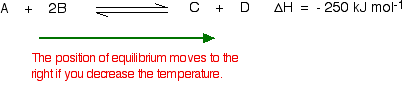
If this reaction at equilibrium is subjected to a decrease in temperature, the system will respond by producing heat and favouring the exothermic reaction. This means when temperature decrease, the exothermic reaction is favoured and vice versa.
Changes in pressure
Equilibira involving gases will be affected by a change in pressure if the reaction involves a change in the number of molecules. This is because there is a direct relationship between the number of molecules and the pressure exerted by a gas in a fixed volume.
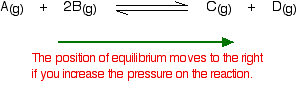
If a reaction at equilibrium is subject to an increase in pressure, the system responds to decrease this pressure by favouring the side with the smaller number of molecules. Conversely, a decrease in pressure will cause a shift in the equilibrium position to the side with the larger number of molecules. Kc will remain constant as long as temperature has not changed.
Changes in concentration
Suppose an equilibrium is disrupted by an increase in the concentration of one of the reactants. This will cause the rate of the forward reaction to increase, while the backward reaction will not be affected, so the reaction rates will no longer be equal. The value of Kc will be unchanged.

7.2.4 State and explain the effect of a catalyst on an equilibrium reaction
A catalyst speeds up the rate of a reaction by lowering its activational energy (Ea) and so increase the number particles that have sufficient energy to react without raising the temperature.
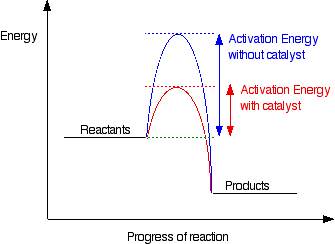
In the equilibrium, both the rate of forward reaction and back reaction increases equally from the catalyst. Thus it has overall no net effect on the reaction.
7.2.5 Apply the concepts of kinetics and equilibrium to industrial processes
A common industrial process used in the IB exams include the production of ammonia.
Haber Process:
.jpg)
Concentration - the reactants nitrogen and hydrogen are supplied in the molar ratio 1:3 in accordance with their stoichiometry in the equation. The product ammonia is removed as it forms, thus helping to pull the equilibrium to the right and increasing the yield.
Pressure - As the forward reaction involves a decrease in the number of molecules, it will be favoured by high pressure. However, anything above 200 atmospheric pressure will not be economically efficient.
Temperature - As the forward reaction is exothermic, it will be favoured by a lower temperature. However, too low a temperature would cause the reaction to by economically slow and so a moderate temperature of 450 degrees Celcius is used.
Catalyst - Thought the catalyst will not increase the yield of ammonia, it will speed up the rate of production and so help to compensate for the moderate temperature used. A catalyst of finely divided iron is used, with small amounts of aluminium and magnesium oxides added to improve its activities.