Showing posts with label Topic 6. Show all posts

Friday, 28 March 2014

Topic 6.2: Collision theory

6.2.1 Describe the kinetic theory in terms of the movement of particles whose average energy is proportional to temperature in kelvins.

The essence of kinetic-molecular theory is that particles in a substance move randomly as a result of the kinetic energy that they possess. However, because of the random nature of these movements and collisions, not all particles in a substance at any one time have the exact same value of kinetic energy. Thus, it is the average kinetic energy. Kinetic energy is directly proportional to temperature.


6.2.2 Describe the term activation energy, Ea.

The minimum energy required for a chemical reaction to take place.


6.2.3 Describe the collision theory.

Reactions take place as a result of particles colliding and then undergoing a reaction. The particles must have sufficient energy and correct orientation.
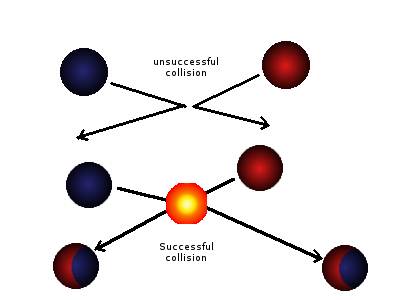


6.2.4 Predict and explain, using the collision theory, the qualitative effects of particle size, temperature, concentration and pressure on the rate of a reaction.


  • Particle size
The smaller the particles, the faster the reaction. Reaction happens on surface and large area = smaller SA. 
  • Temperature
Increase temperature, increase rate of reaction. More sufficient energy particles and more collisions
  • Concentration
Increase concentration, increase rate of reaction. More collisions at closer proximity 
  • Pressure
Increase pressure, increase rate of reaction. More collisions at closer proximity.


6.2.5 Sketch and explain qualitatively the Maxwell-Boltzmann energy distribution curve for a fixed amount of gas at different temperatures and its consequences for changes in reaction rate.

The area under the curve must stay constant. The average temperature which is proportional to KE shifts accordingly. The peak also shifts accordingly.


6.2.6 Describe the effect of a catalyst on a chemical reaction
  • Catalyst
Presence of catalyst, increase rate of reaction. Catalyst finds an alternative pathway thus lowering the activation energy.


6.2.7 Sketch and explain Maxwell-Boltzmann curves for reactions with or without catalysts.


Because catalyst can find alternative pathways. Thus, the Ea shifts to the left allowing more particles to react at a lower KE.

Topic 6.1: Rates of reaction

6.1.1 Define the term rate of reaction

The rate of a reaction is the increase in concentration of products (or the decrease in concentration of reactants) per unit time. It is measured in mol dm^-3 s^-1


6.1.2 Describe suitable experimental procedures for measuring rate of reaction

There are several suitable experimental procedures

  • Change in volume of gas produced
Gas syringe or inverted beakers to collect gas produced
  • Change in mass
If the reaction is giving off a gas, the corresponding decrease in mass can be measured by standing the reaction mixture directly on a balance.
  • Change in transmission of light: colorimetry/spectrophotometry
As the concentration of coloured compound increase, it absorbs porportionally more light, so less is transmitted. A photocell generates an electric current according to the intensity of the light transmitted.
  • Change in concentration measured using titration
Through the method of quenching, we could obtain freeze frames from the experiment. Thus showing all the points.
  • Change in concentration measured using conductivity
Conductivity can be measured directly using a conductivity meter.
  • "Clock reaction"

Simply measures the time taken to reach its final point. Thus the rate given is an average.


6.1.3 Analyse data from rate experiments

There will be a steady decreasing rate of temperature.

Assuming that the decrease of temperature is uniform, we could deduce the original temperature without heating process.

Thus, find the temperature change and calculate the for enthalpy change.

Topic 6: Kinetics

Topic 6 of the IB HL Chemistry syllabus is the Kinetics. IBO recommends to spend 5 hours on this topic.

This topic has 2 sub-chapters: "Rate of reactions" and "Collision theory". Each are separated with numerical values in order of mentioned.

These are SL syllabus statements, it is recommended to bring a Casio Graphical Calculator instead of Texas. Casio Calculators have the periodic table installed already.