14.3.1 Describe the delocalization of π electrons and explain how this can account for structures of some species.
Instead of being confined to one location, electrons show a tendency to be shared between more than one bonding position, and are said to be delocalized. Free from the constriants of a single bonding position, delocalized electron spread themselves out.
Delocalization is a characteristic of electrons in pi bonds when there is more than one possible position for a double bond within a molecule. For example, if we consider the structure of the nitrate ion.
It can inter-change from any of the different Lewis structures.This suggests that the pi electrons have delocalized and spread themselves equally between all three possible bonding positions. This is the Lewis structure normally drawn.
Resonance is introduced because it can't be represented in a single diagram. The actual structure of the species is a composite or average of the number of Lewis structures that can be drawn, each known as a resonance structure.
Other resonance structures include carbonate, ozone and methanoate.
Benzene is a particular interesting case as all the carbons have made sp^2 bonds.
Because the p orbitals are so close together, they form a huge cloud instead.
This allows the electron to move freely around the benzene hexagon. This is easily portrayed in a Lewis Structure.
Delocalized electrons gives special properties to the structures in which they are found.
Intermediate bond lengths and strengths
By spreading the electrons between more than one bonding position, delocalization causes the affected bonds to be equal each other in length and strength, with values in between those of single and double bonds. The concept of bond order is sometimes used to describe the electron density within the bond. It is calculated by how many bonds divided by number of bonding positions. The higher the bond order, the greater the electron density
Greater Stability
Species with delocalized electrons are more stable than related species with all electrons localized in bonds. This is because delocalization spreads electrons as far apart as possible and so minimizes the repulsion between them. They require extra energy called resonance energy to disrupt the delocalized pi electron cloud.
Electrical conductivity in metal and graphite
Structures that have delocalized electrons spread through the entire structure (graphite). This enables them to move in response to a potential difference applied. In other words, conduct electricity.
Showing posts with label Topic 14. Show all posts
Sunday, 17 November 2013
Topic 14.2: Hybridization
14.2.1 Describe σ and π bonds
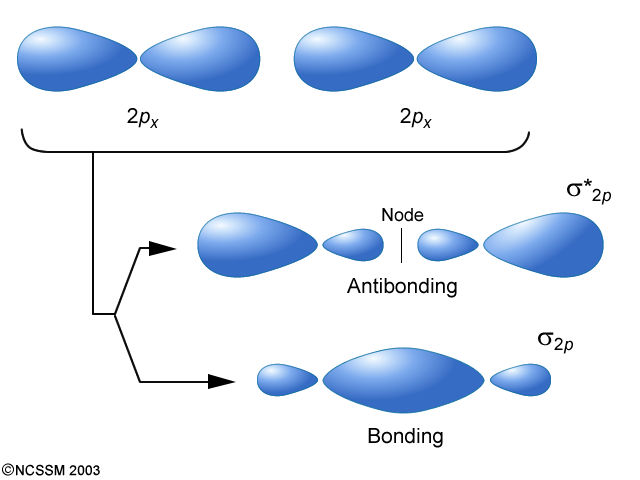
When two atomic orbitals overlaps along the bond axis - an imaginary line between the two nuclei - the bond is described as a sigma bond. Denoted as σ. This type of bond forms by the overlaps of s orbitals, p orbitals and hybrid orbitals.
14.2.2 Explain hybridization in terms of the mixing of atomic orbitals to form new orbitals for bonding.
Carbon forms four covalent bonds. Yet if we consider the electron configuration in the carbon atom, we would not predict this as it has only two singly occupied orbitals available for bonding.
Because carbon can have 4 covalent bonds, this indicates that this lowest energy or ground state electron configuration changes during bonding. The electron in 2s is promoted to 2p by the process of excitation. The atoms now have 4 singly occupied orbitals available for bonding.
14.2.3 Identify and explain the relationships between Lewis structures, molecular shapes and types of hybridization (sp, sp^2 and sp^3)
Though this process can explain the four covalent bonds, the three p orbitals should have a slightly higher energy than the s orbital. So if there were used in bonding, we would expect unequal bonds. However methane has four identical bonds, so we can safely assume that the orbitals have been made equal during the bonding process. They form new hybrid atomic orbitals which are the same as each other, but different from the original orbitals.This mixing of orbitals is called hybridization.
sp^3
When carbon forms four single bonds, it under goes sp^3 hybridization, producing 4 equal orbitals. Note that it should have a tetrahedral arrangement.
sp^2
When carbon forms a double bond, it undergoes sp^2 hybridization, producing three equal orbtials. This typically forms, double bonds as the remaining p orbital becomes part of the pi bond. Note that it should have a planar triangular arrangement.
sp
When carbon forms a triple bond, it under goes sp hybridization, producing two equal orbitals. Note that it should have a linear arrangement.
These coalesce into a cylinder of negative charge around the atom, making the molecule susceptible to attack by electrophilic reagents.
Non-bonding pairs can also take part in hybridization. The non-bonding pair in ammonia, NH3, resides in a sp^3 orbital.
Note: Look at the number of charge centres, then the shape of the molecule. Then you would be able to find the type of hybridization.
When two atomic orbitals overlaps along the bond axis - an imaginary line between the two nuclei - the bond is described as a sigma bond. Denoted as σ. This type of bond forms by the overlaps of s orbitals, p orbitals and hybrid orbitals.
When two p orbitals overlaps sideways, the electron density of the molecular orbital is concentrated in two regions, above and below the plane of the bond angle. This type of bond only forms by the overlap of p orbitals alongside the formation of a sigma bond. In other words, pi bonds only form within double bond or triple bond.
14.2.2 Explain hybridization in terms of the mixing of atomic orbitals to form new orbitals for bonding.
Carbon forms four covalent bonds. Yet if we consider the electron configuration in the carbon atom, we would not predict this as it has only two singly occupied orbitals available for bonding.
Because carbon can have 4 covalent bonds, this indicates that this lowest energy or ground state electron configuration changes during bonding. The electron in 2s is promoted to 2p by the process of excitation. The atoms now have 4 singly occupied orbitals available for bonding.
14.2.3 Identify and explain the relationships between Lewis structures, molecular shapes and types of hybridization (sp, sp^2 and sp^3)
Though this process can explain the four covalent bonds, the three p orbitals should have a slightly higher energy than the s orbital. So if there were used in bonding, we would expect unequal bonds. However methane has four identical bonds, so we can safely assume that the orbitals have been made equal during the bonding process. They form new hybrid atomic orbitals which are the same as each other, but different from the original orbitals.This mixing of orbitals is called hybridization.
sp^3
When carbon forms four single bonds, it under goes sp^3 hybridization, producing 4 equal orbitals. Note that it should have a tetrahedral arrangement.
sp^2
When carbon forms a double bond, it undergoes sp^2 hybridization, producing three equal orbtials. This typically forms, double bonds as the remaining p orbital becomes part of the pi bond. Note that it should have a planar triangular arrangement.
sp
When carbon forms a triple bond, it under goes sp hybridization, producing two equal orbitals. Note that it should have a linear arrangement.
These coalesce into a cylinder of negative charge around the atom, making the molecule susceptible to attack by electrophilic reagents.
Non-bonding pairs can also take part in hybridization. The non-bonding pair in ammonia, NH3, resides in a sp^3 orbital.
Note: Look at the number of charge centres, then the shape of the molecule. Then you would be able to find the type of hybridization.
Topic 14.1: Shapes of molecules and ions
14.1.1 Predict the shape and bond angles for species with five and six negative charge centres using the VSEPR theory.
Expanded Octet is when compounds have more than eight electrons around the central atom is possible because the d orbitals avaliable in the valence shell of these atoms have energy values relatively close to those of the p orbitals. So promtions of electrons from 3p to 3d orbitals will allow additional electron pairs to form. This is how elements such as phosphorus and sulfur expand their octets forming species with five or six charge centers.
This table shows all the shapes you need to know. Remember the names for all of the different shapes.
A is central atom
X are other atoms
E are lone pairs
Five negative charge centres.
Triangular bipyramidal
Consists of 90 degrees, 120 degrees and 180 degree bonds.
Seesaw
With one pair of lone pair, it reduces the degree is reduced from 120 to 117 between the angles
T-shaped
With two pairs of lone pair, the bond angles are 90 degrees and 180 degrees.
Linear
It is just 180 degrees
Square Pyramidal
All degrees are <90 degrees or <180 degrees.
Square Planar
All angles are 90 degrees or 180 degrees
Summary
2 charge centers are linear
3 charge centers are planar triangular
With lone pair V-shaped
4 charge centers are tetrahedral
With lone pair Pyramidal
With 2 lone pair V-shaped
5 charge centers are triangular bipyramidal
With lone pair See-saw
With 2 lone pair T-shaped
With 3 lone pairs Linear
6 charge centers are octahedral
With lone pair Square pyramidal
With 2 lone pair Square planar
Expanded Octet is when compounds have more than eight electrons around the central atom is possible because the d orbitals avaliable in the valence shell of these atoms have energy values relatively close to those of the p orbitals. So promtions of electrons from 3p to 3d orbitals will allow additional electron pairs to form. This is how elements such as phosphorus and sulfur expand their octets forming species with five or six charge centers.
This table shows all the shapes you need to know. Remember the names for all of the different shapes.
A is central atom
X are other atoms
E are lone pairs
Five negative charge centres.
Triangular bipyramidal
Consists of 90 degrees, 120 degrees and 180 degree bonds.
Seesaw
With one pair of lone pair, it reduces the degree is reduced from 120 to 117 between the angles
T-shaped
With two pairs of lone pair, the bond angles are 90 degrees and 180 degrees.
Linear
It is just 180 degrees
Six negative charged centres
Octahedral
All 90 degrees or 180 degrees bond.
Square Pyramidal
All degrees are <90 degrees or <180 degrees.
Square Planar
All angles are 90 degrees or 180 degrees
Summary
2 charge centers are linear
3 charge centers are planar triangular
With lone pair V-shaped
4 charge centers are tetrahedral
With lone pair Pyramidal
With 2 lone pair V-shaped
5 charge centers are triangular bipyramidal
With lone pair See-saw
With 2 lone pair T-shaped
With 3 lone pairs Linear
6 charge centers are octahedral
With lone pair Square pyramidal
With 2 lone pair Square planar
Topic 14: Bonding
Topic 14 of the IB HL Chemistry syllabus is the Bonding. IBO recommends to spend 5 hours on this topic.
This topic has 3 sub-chapters: "Shapes of molecules and ions", "Hybridization" and "Delocalization of electrons". Each are separated with numerical values in order of mentioned.
These are advanced HL syllabus statements, it is recommended to bring a Casio Graphical Calculator instead of Texas. Casio Calculators have the periodic table installed already.
This topic has 3 sub-chapters: "Shapes of molecules and ions", "Hybridization" and "Delocalization of electrons". Each are separated with numerical values in order of mentioned.
These are advanced HL syllabus statements, it is recommended to bring a Casio Graphical Calculator instead of Texas. Casio Calculators have the periodic table installed already.
Subscribe to:
Posts (Atom)